The newspaper is an excellent learning resource for secondary students , especially in the areas of current history/culture, journalism and reading comprehension. Every weekday The New York Times provides new free educational resources based on the content published in the newspaper. Click on the image below to browse The Learning Network’s teaching and learning resources. 
Blog
Daily Learning for Secondary Students using the NYT
The newspaper is an excellent learning resource for secondary students , especially in the areas of current history/culture, journalism and reading comprehension. Every weekday The New York Times provides new free educational resources based on the content published in the newspaper. Click on the image below to browse The Learning Network’s teaching and learning resources.
Show & Share ~ March 19, 2014
Welcome to the March 19th Edition of Show & Share. We look forward to enjoying what you have to share today. For Show & Share ideas and guidelines, read this post.

Something to Consider
 Are you putting as much time and attention into your child’s spiritual growth as you are into his/her academic growth?
Motivation Monday
 “Parents should keep ever before their minds the object to be gained—the perfection of the characters of their children. Those parents who educate their children aright, weeding from their lives every unruly trait, are fitting them to become missionaries for Christ in truth, in righteousness, in holiness. He who in his childhood does service for God, adding to his “faith virtue; and to virtue knowledge; and to knowledge temperance; and to temperance patience; and to patience godliness; and to godliness brotherly kindness; and to brotherly kindness charity” (2 Peter 1:5-7), is fitting himself to hear and to respond to the call, “Child, come up higher; enter the higher school.”
Counsels to Parents, Teachers, and Students, Page 162
Book Review: Pocketful of Pinecones by Karen Andreola
Pocketful of Pinecones
Nature Study with the Gentle Art of Learning
A Story for Mother Culture
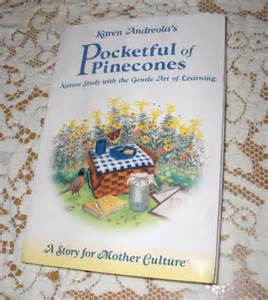
Pocketful of Pinecones is not a book your child would read, but rather a book for Mom to read. This book is a historical-fictional type book, mixed with good science. Karen weaves a fictional story around personal experiences and true stories that she has heard through the years. Her goal in writing the book was to give an honest report of what nature study may look like in the life of a family. She is sharing the Charlotte Mason way of teaching nature study to your children.
As a Seventh-day Adventist, you will run across an occasional mention of Saturday shopping or Sunday church activities. This did not bother me, but it is in there, nonetheless. I really liked the style of the Charlotte Mason way of Nature Study. This is very much in line with how Ellen White instructed us to introduce our children to nature.
While I believe she did a great job sharing this style of teaching, I personally would add more emphasis on God’s creation. Meaning, I would want to be reminding my children, if they are quite young about how God’s creation was so interesting, so unique, so particular to details, etc. I would try to add in a few object lessons a bit more often. I believe the book may have shared that aspect once or twice, and her goal was to include as many different instances in teaching nature study to our children, not to repeat the same style over and over again. So I am not disappointed, as the different ways to easily or naturally include nature study into our days is important. However, my personal style would be to focus on bringing my children to God as the creator more often or to focus on object lessons within the nature study.
The book offers an appendix Supplement of specific Charlotte Mason quotes and pages to read. They are interesting and very much in line with counsel from Ellen White. Also included is a Suggested Reading appendix, in which she referenced different titles of works in her book, and also titles that she feels are useful for additional nature study references. I have not read all of those titles, so I cannot verify whether they are good suggestions or not. She then ends the section of Appendices with how she came up with the story line and how she gathered the different stories.
Overall, I really enjoyed the book. I feel it gives an honest look of how nature study over an entire year might play out. She goes through seasons, and has days or even a week or more where nothing is touched and they come back to nature study. This book is a journal style book of the Mom’s recollections of the day, so the dates are scattered, which is often a realistic view of nature study. While we can schedule nature study in our days from 10 to 10:30 a.m., it often becomes more natural and fulfilling to take time to notice nature in your days as you come across it. I like this style of teaching, more of a taking time to smell (and observe) the roses in life.
~
Your turn! Please rate this curriculum if you have used it in your homeschool and feel free to leave a comment so others can learn more about this product.
If you have used something in your homeschool and would like to review it here, please contact us at adventisthomeducator@gmail.com
Show & Share ~ March 12, 2014
Welcome to the March 12th Edition of Show & Share. We look forward to enjoying what you have to share today. For Show & Share ideas and guidelines, read this post.

 The Adventist Home Educator