Looking Back: Organization

Organization

Household organization and cleaning seem to be a mysterious burden for all of us.  In answer to your requests this new column will pass along hints and ideas.  Feel free to contribute your own tips.

We devoted the September, 1994 issue of AHE to organization.  Mainly homeschool records, but also a little “fall house cleaning” and getting ready to start the new school year.  Since then, I’ve received letters and phone calls expressing your frustration and need for more help in this area.  Homeschoolers are constantly in their homes and I know that they have a tendency to become messy much faster than homes where the family is gone all day.

Now I’m not an expert at this, but I am a melancholy by nature and I can’t tolerate messy surroundings.  I’m always looking for ways to keep my home, work area, files and schedule organized and clean without spending a lot of time doing it.  I have found lots of ideas, information, and cleaning tools and supplies from Don Aslett’s Cleaning Center, P. O. Box 39, Pocatello, ID 83204.  Write for a free copy of the Clean Report which arrives in a file folder marked Cleaning.*  I read about the various ways to clean and the professional supplies to use, and I have proved it myself, it pays in time and money to do it right using the proper tools and cleaning supplies. I set a monthly amount to spend and slowly built up what we needed as we ran out of grocery store brands, replaced them with professional cleaning products.

Children and Husbands

So since you asked for it, I’m starting this little column with tips and ideas to help make life a little easier.  I’m going to start with the biggest problem of all – children and husbands.  I read in one of Don Aslett’s books that 90% of the messes are made by children and husbands, and that 90% of these messes are cleaned up by the woman of the home.  By the way, he agrees with me, husbands and children should participate in picking up their own clutter.

The best rule for keeping a home organized is to have a place for everything and put everything in it’s place.  This means to have a bookshelf or special place for school books and work when they aren’t in use.  A toy box of some kind to put away toys is imperative.  It also helps to have a place where the children can work on projects and not have to clean them up before each meal.

Have two or three times during the day when everyone helps to pick up the house for five minutes.  Just before school starts, before or after lunch and then again before bedtime are good times.  Even toddlers can help with this project and it really helps keep down the clutter of toys, books and other things.  Half of the housework is picking up and putting away things that others leave out!

Make a household rule that if someone puts something down where it doesn’t belong they will pay a fine (1-15 cents depending on individual resources) or do a chore, to get it back.  Children (and husbands) will quickly learn to put things where they belong.  Donate the money you collect to investment or missions.

Another good rule is if you make a mess, you clean it up.  This teaches children to clean up after themselves.  You may have to touch-up or help at first but it’s a good habit.

The best advice I’ve ever been given was from Dorothy Moore.  She said, “Don’t do anything for your children that they are capable of doing for themselves.”  She meant making beds and picking up after themselves, etc.  We are not the maid, we are the mother and we must train our children to help keep the home tidy and clean just as we discipline or homeschool them.

Turn your young mess makers into helpers.  I was longing for a maid when my daughter expressed a desire to earn money.  I had my “maid!”  Each child has their daily chores which they do just because they are part of a family and those things that have to be done daily.  But I pay for cleaning bathrooms, scrubbing the stove, washing the car, heavy duty cleaning, etc.  Not much, 20-75 cents per chore but it provides her with a small income, and I get much needed help.

I hope these ideas help you tame the messiness around your home.  Remember this is an ongoing process – keep working at it and you will be rewarded.

Article from The Adventist Home Educator Newsletter, February 1995, p. 6.

*Resources have not been checked out to see if they are still available.

Continuing Education… for the Parents…

Many times we feel like we have no extra time as homeschooling parents to squeeze into our days, especially for reading books.  We hear others that have read books on different educational styles, learning styles, homemaking and more.  Sometimes that is discouraging and we feel like we’ll never get to that book pile that sits on our bedside table.

I will admit to being in that group that couldn’t figure out where to squeeze in time to go visit my book pile.  Before, I used to do school at the dining room table and we were always moving books on and off the table, so having books near me didn’t work very well.   I also took advantage of short breaks for me to step into the kitchen to get a meal started.  While that was nice at the time, I never felt like I got ahead on anything.  I also tried reading on my laptop, but found that I often got distracted from my book when I heard my email “ding”.

I did, however, come up with an idea that is solving that problem for me.  I know it will sound simplistic, but it is working for me.  We recently moved a table into an area just at the top of the stairs where we now do most of our sit down work.  I have a pile of books that sits next to me at the table, and I never have to clear this table.  I have several books that I am working on at the same time.  When my daughter has some work to do, instead of running off and getting distracted and her needing to pull me back to the table because she had finished, I now just choose a book that I can read for 5 or 10 minutes while I wait for her to finish.

book pile

I am finding this is helping me get through my book piles.  It is also keeping me from getting distracted and keeping my daughter from running off when she thinks I’m too busy to help her with something else. I also am not distracted by email when I stick to reading “books” rather than reading online in a kindle or nook app.  School is getting done in a timelier manner and I am accomplishing more.

Sometimes getting more done is a matter of organizing your space to make it work for you.  Please share in the comment section how you make time and space for your reading hobby and time for continuing education.  

Curriculum Review: Lessons in Responsibility for Girls, Level 3 from Pearables

homeecpearables

Title: Lessons in Responsibility for Girls (Quiet Arts Series) Level 3 (Age 10 & up) from Pearables

Also published as: Home Economics for Home Schoolers

This book covers some a few aspects of health, how to choose and cook vegetables and fruits, various cooking methods, how to make dessert, breakfasts, bread, etc. It also covers how to iron and do basic sewing and how to use a commercial pattern, as well as hot to organize and clean your kitchen. It ends with two chapters on hospitality. It is in black and white and has quite a few drawings throughout. The thirty chapters are short and include recipes and practical activities. Each chapter includes a story about “Patience”, a home schooled girl who was learning home economics, which makes it even more interesting for children. This is a textbook, not a workbook.

I have used this book with my 8 and 10 year old daughters this year and they have really enjoyed it. It has prompted them to try recipes they would not have been excited about otherwise, and I like the Bible verse that they have for each topic that is printed under that chapter’s picture. I felt the content was solid, useful, and well-presented. We learned unexpected things like why people are overweight or underweight, vitamins, and much more. Many of the recipes needed to be adapted for a vegetarian/vegan diet. They did try to use healthful recipes, but I felt they could be much more healthful, so we often used our own recipes. There is a chapter on choosing healthy snacks, like popcorn, so I think we just thought of those as part of a meal.

All in all I would highly recommend this book, even for those who have already taught their kids some cooking and sewing, like I had. It definitely expanded our horizons. I wish we’d done the other two levels when they were younger, as we’ve enjoyed this one so much.
 
Review by Heather K.

Now it’s your turn…

Please rate the item by hovering over the stars and click your vote in. Please use the comment box below to share more details about your vote with other homeschoolers.

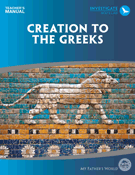
Curriculum Review: My Father’s World – Creation to the Greeks

Curriculum: My Father’s World
Year: “Creation to the Greeks” Grades 2-8

My Father's World. Creation to the Greeks

I chose this curriculum this year because it it an integrated, Christian-based curriculum that covers science, history, social studies and Bible and can be used for children at various grade levels simultaneously. Also, I wanted our 3rd and 5th grade girls to study more in-depth into the old testament, which it covers. It is a 34-week curriculum with daily lesson plans that make it very easy to use. Various easily-obtainable and interesting books are required. Student notebook pages are provided. As you go along the children make a time-line of events (quite elementary), do various notebook pages and you read to them about ancient civilizations. My children really enjoyed learning about Egypt and the pyramids, mummies, etc. There are quite a few hands-one projects to do, and they don’t take very long each day. Jewish Feasts are studied in the first few months. There are plenty of hands-on activities that can be done in preparation to celebrate the feasts. The Sanctuary is also part of the curriculum and kids can make a paper model of it. Later Greek mythology is covered. They do use books like Aesop’s Fables, which we are specifically counseled to avoid, according to the Spirit of Prophecy, so we have not done that part. There are read-aloud books recommended, which did not seem to be up standard for our family, so we did not use those. They are optional. Music and art are included in the weekly program, but are also optional. They do teach Greek vocabulary words, which was interesting. There are lots of supplemental books (often available at the public library) suggested.

We have enjoyed having a curriculum where everything is laid out. A whole year on this time-period may be a bit much, but the curriculum is not heavy or full and so we have plenty of time to supplement with other topics and studies of our choice. I feel that the Bible lessons need to be supplemented. They do have the kids memorize scripture, but it is mostly passages we already know, like the ten commandments. For Bible they use “Victor Journey Through the Bible”, which is very good, but does not take long to cover. There is a story to read from the Bible itself almost every day. You have to use your own Language Arts and Math curriculum. It is not included with this curriculum.

Review by Heather K.

Now it’s your turn…

Please rate the item by hovering over the thumbs up or thumbs down icons and click your vote in. Please use the comment box below to share more details about your vote with other homeschoolers.

ScriptureTyper.com; Website Review

What it is:

ScriptureTyper.com is a website where you can practice typing speeds while memorizing scripture.  If you have a desire to increase the speed of your child’s typing ability, you can do this while memorizing scripture at the same time.  There are many options you can choose from to personalize the experience for you or your child.  You will need to create an account to save your progress and take advantage of the review options.

Go to ScriptureTyper.com

SDA Notes:

Because this program uses scripture and not spiritual thoughts, it is a safe place to have your child practice typing.  There should be no worries of tainted views on scripture.

My Thoughts:

My daughter was looking for some typing practice to increase her wpm in which she had a prerequisite for a college class.  Because we updated to Windows 8, our typing program was no longer working.  I looked online and found several typing programs, but the material being practiced wasn’t always something that I could say was edifying for her to dwell on.  I was pleased when another homeschool Mom shared this site with us as it fit everything my daughter needed to increase her skills and it also kept me happy as a Mom, to know that her thoughts would be dwelling on something that would also help her spiritual walk as well.

Review by Melissa B.

Now it’s your turn…

If you’ve used rated items before, we changed the icon. We thought a thumbs up/thumbs down would show better how people like or dislike an item. Please use the comment box below to share more details about your vote with other homeschoolers.


On Solid Ground, Week of Prayer 2013 DVD’s

Thank you for joining us last month for Week of Prayer, On Solid Ground!

I hope you all enjoyed it as much as we did!  The interaction via the blog and our Facebook Page was nice and it was encouraging to hear from day to day where people were checking in from.  It’s times like these, that we don’t quite feel so alone in what we are doing!  We realize that not everyone was able to watch the videos that very week.  For those that missed Week of Prayer, we are now offering the set of 5 programs, copied onto two DVD’s.

WOP2013 small

DVD’s will be available for $15 per set with free shipping in the main 48 states of the United States.  If you are out of the United States (main 48), we ask that you contact us before trying to purchase so we can figure out (individually) how to get these to you in a cost effective manner.  You can also email us for more information at adventisthomeducator@gmail.com.

To Purchase the On Solid Ground DVD’s, you will need to go to PayPal.com and make a PayPal payment of $15 to adventisthomeducator@gmail.com

Please remember to include your mailing address so that we can mail these out to you.   We will be able to begin shipping after April 15th, 2013.

Thoughts on Schedules, Part 2 of 2

Dr. Raymond Moore, and his wife Dorothy, often spoke of creating a schedule.  They focused on what they called “anchors”.  These anchors are the parts of life that need to be regular.  Think of rising and sleeping times, mealtimes, nap-times, a spouse’s work schedule (if regular), etc.  These are things that you will work your routines around.  These are the “stable” parts of life. anchor You will see after creating a schedule with anchors that you still have quite a bit of your day that is empty.  These empty places in your schedule are where you get to add in the parts of the day that have a little more flexibility, things like chores and study routines, music lessons, church activities, and more.

Be careful not to try to schedule every minute of your day for you will become a slave to your schedule.  The schedule is there to help you, not to make you miserable.  If you haven’t worked with a schedule before, give yourself some growing time. If you notice that you are not good with the anchors, don’t try to change all your ways at once.  Try choosing one and being deliberate in making it work.  Put your attentions on that one routine until it becomes common to you.  Once it is a regular part of your day and you don’t have to think so hard about it, move on to the next one.

Another thought is that a schedule is just a way to organize your daily routines.  This helps you see if you are getting everything done that you wish to get done.  Just as a financial budget helps to keep you from overspending, a schedule helps you from taking on too much.  If you can’t get everything done, you probably are trying to do too much.

We also need to be temperate in our daily activities.  We can’t spend 4 hours exercising and still get everything done in a day.  We need smaller increments of time for some of our activities and we need to learn to set aside things when our time allotted is up.  This is especially important for those activities which tend to be time stealers, leisure activities like internet browsing, TV watching, reading emails, etc.  However, we can also choose to do “good things” to excess, as well.  Practicing music for several hours a day and not getting any exercise is not good for us either.  Balance is a very important concept to keep in mind as you plan your schedules and routines.

Schedules and routines are very enjoyable for a child.  Children like having some control in their days.  Schedules and routines give them some control.  They know perhaps that when mom starts making dinner that it is time for them to wash their hands and help set the table.  They don’t have to be told to do things all the time and when they remember to do things they’ve been taught, they feel some sense of control and a sense of responsibility by being able to follow those routines.  When we live in disorder and our kids do not know when breakfast will be eaten or when school will start or when family worship will be done, our children become restless waiting.  They are waiting for some favorite parts of the day to happen.  They are waiting and sometimes those activities never happen.  It is discouraging for them, as well as us, to live in constant chaos.  They become irritable; we become irritable.  They struggle to listen and respect us, because it seems that nothing gets done when it is said to be done.  We get distracted and our kids get distracted as well.  Sometimes we then yell at our kids when it is “us” who needs the talking to as it is our example that has created a child that has no sense of responsibility.

plannerThere is hope.  God loves order and He will give us order in our lives.  Sometimes we just need a little reminder, or maybe we need to learn in an area that we were never taught about why something is important to implement in our homes.  Either way, do not be discouraged.  Take a deep breath, say some prayers, get some resources if you need some help, and let God direct your paths.

*As a disclaimer, we are not asking anyone to have a rigid schedule or routine.  We all must be flexible to the things happening in our lives.  A flat tire can set an entire day off.  A sickness or death in the family can create a temporary setback in our routines. An emergency call for help should not always be ignored because we did not schedule it in.  We just need to be aware of how often these unscheduled interruptions happen in our life.  Sometimes others learn that we can be easily swayed to talk on the phone when it’s time for math.  Sometimes others call on us for help because we’re “home” and not working.  Once in a while is okay, but you may find that it is happening all too often and you are struggling to keep your home clean, you are struggling to get studies done, you are struggling to live the homeschooling life that you had once felt strongly called to.  It is these times that we need to reevaluate our lives and reorganize them, if needed, so that we can continue to do that which we feel called to accomplish.  It is times like this, where we can change our schedules to allow for a phone call from friends, to help an ill family member, and still get the other things done, rather than setting them aside and being frustrated that we never get it all done.  Remember schedules and routines are just tools to help you keep your life less stressed and more on track.

Resources for Schedules and Routines

Adventist Home by Ellen White (helpful topics to consider)

Child Guidance by Ellen White (helpful topics to consider)

Fly Lady (main program is helpful for cleaning routines) – they even have a free app!

Managers of Their Homes by Terry Maxwell (helpful especially for large families)

The Moore Formula Manual by the Moore Academy Staff

The Successful Homeschool Family Handbook by Dr. Raymond and Dorothy Moore

The Well Planned Day Planner Books