Charlotte Mason Scripture Memory System – Guest Post

Many thanks to Yolanda for sharing this post with us.

When I was a child I attended Pensacola Christian Academy, a private Christian School well-known for the A Beka curriculum. One thing I remember most about school is the scripture memorization. We would learn large passages of scripture and then individually stand in front of the class and recite them.

This planted a love in my heart for God’s Word. When I began homeschooling my children, I knew that I wanted to instill in them the same love for God’s Word.   I wanted to create a habit of learning scriptures and reviewing them so they would be retained.

I came across the Charlotte Mason Method of teaching scripture. In this method, scriptures are added and reviewed every day, then every other day and then once a month. I know that it is working for my family because my children beg to “do the scripture memory box”!
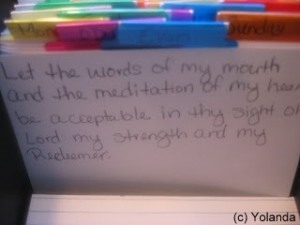
You can view how to set up the box HERE.  The box that we use to hold our cards can be found HERE. We use our box in the morning before breakfast during our family worship time. It literally only takes a few minutes and it’s small enough to pack up and take on any trip.

My children are ages 12 (13 next month) and 8.  We memorize longer passages such as the ten commandments and the 23rd Psalm as well as short verses such as Genesis 1:1.  Our home school curriculum includes several verses to memorize for each lesson, and I also choose verses that God may impress on my heart during my morning worship.  Once my children seemed to be having a rough time getting along and so we chose Romans 12:18.  “If it be possible, as much as lieth in you, live peaceably with all men.”

When reviewing the verses we have already memorized, I give only the scripture reference and the children recite the verse.  For my 8 year old, I may have to give the first word or two of the verse to help jog his memory.

Charlotte Mason Scripture Memory System – Guest Post

Many thanks to Yolanda for sharing this post with us.

When I was a child I attended Pensacola Christian Academy, a private Christian School well-known for the A Beka curriculum. One thing I remember most about school is the scripture memorization. We would learn large passages of scripture and then individually stand in front of the class and recite them.

This planted a love in my heart for God’s Word. When I began homeschooling my children, I knew that I wanted to instill in them the same love for God’s Word.   I wanted to create a habit of learning scriptures and reviewing them so they would be retained.

I came across the Charlotte Mason Method of teaching scripture. In this method, scriptures are added and reviewed every day, then every other day and then once a month. I know that it is working for my family because my children beg to “do the scripture memory box”!

You can view how to set up the box HERE.  The box that we use to hold our cards can be found HERE. We use our box in the morning before breakfast during our family worship time. It literally only takes a few minutes and it’s small enough to pack up and take on any trip.

My children are ages 12 (13 next month) and 8.  We memorize longer passages such as the ten commandments and the 23rd Psalm as well as short verses such as Genesis 1:1.  Our home school curriculum includes several verses to memorize for each lesson, and I also choose verses that God may impress on my heart during my morning worship.  Once my children seemed to be having a rough time getting along and so we chose Romans 12:18.  “If it be possible, as much as lieth in you, live peaceably with all men.”

When reviewing the verses we have already memorized, I give only the scripture reference and the children recite the verse.  For my 8 year old, I may have to give the first word or two of the verse to help jog his memory.
August Brings


August brings the sheaves of corn,

Then the harvest home is borne.*

August! This month is a back-to-the­ books transition time for many homeschool households, so let’s  enjoy the dog days of summer and get our school plans organized!

In many parts of the US right now, it is very hot. Enjoying a museum is a cool treat. How about enjoying a trip to the Library of Congress from the comfort of your living room? Enjoy multimedia digital collections with the click of a mouse and no travel expenses!

Combine nature study with creative play by making your own natural dyes for playdough. Your children will enjoy finding out what colors the environment around them can provide. * Hat tip to LaDonna for this great link!

Does adding nature study to your homeschool curriculum feel daunting because you don’t feel knowledgeable or creative enough? Try visiting the Handbook of Nature Study blog. You’ll find free downloads, printables and enough nature challenges to last all school year. A great site to bookmark.

If you haven’t visited Donna Young’s site before, you are in for a treat. Her site features a wonderful array of free printable homeschool calendars, organizers, lesson plan templates and more.

*The Garden Year, by Sara Coleridge

Oakie, the Nature Study Tree

Following a particular tree for a year is a fun nature study activity.  The tree does not need to be at your home, it could be in a park , library or anywhere you can have access to the tree year-round.  Our family chose a tree on our property to follow for a year, but have found that, three years later, we are still keeping track of the life of our favorite tree.  Let me introduce you to Oakie, our nature study tree.

As a supplement to our nature studies, three years ago,  my children and I decided to choose one tree on our property to focus on for nature study. I thought it would be an easy choice, but with nearly 30 trees on our 2 acres, there was a  bit of debate. Finally, we made a choice.

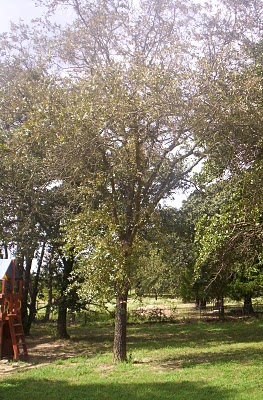
This tree is not the largest or loveliest tree in our yard by any means, but it gets lots of attention and action in and around it. Oakie is right next to the children’s play set, and it is where we hang three bird feeders. We have watched this tree every day for nearly 3 years.

We started out by naming the tree Oakie and then collected some leaves for our nature notebooks. We drew  pictures of the tree for each season and discussed theories on why the tree leans to one side. (hard to tell in the photo) We compared the leaves and acorns of this oak to the other oak trees in the yard and discovered we have at least 3 different types of oak trees on our property!  We made bark rubbings, measured the circumference of the tree several times during the school year and studied the wildlife that visit the tree. The Handbook of Nature Study gave me some good discussion points to share, and we had a great time getting to know our tree.

Three years later, we still check the upper branches to see what bird is waiting on a refill at the feeders.  We know which branches the squirrels like to use most, and where the woodpecker likes to hunt for insects. We still press its petite red leaves in books every fall.   Oakie survived a straight-line windstorm that threw the children’s play set against it.  The play set sustained serious damage, but Oakie came through unscathed.   Compared to the larger, more stately oaks and hickories on our property, Oakie is not much to look at, but  we love our scraggly little nature-study tree.   We encourage you to find a tree to study and love as well.

July Brings


Hot July brings cooling showers,

Apricots and gillyflowers…

Our July themed post is a bit late thanks to General Conference, but let’s celebrate anyway, shall we?

Those of you who missed any of the General Conference programs can catch up at the Hope Channel’s Media Library.

July always brings hot temperatures, now is a great time to learn how to read a thermometer. Hang up an outdoor thermometer and track the weather for a week. You can even make your own thermometer HERE! Create a simple bar graph and you’ve done a simple summer math project.

July 13 is Go West Day, so let’s join Lewis and Clark in an online adventure from National Geographic!

Armstrong and Aldrin landed on the moon on July 20, commemorate the day with some fun activities found HERE.

Motivation Monday

“Let the study of books be combined with useful manual labor, and by faithful endeavor, watchfulness, and prayer, secure the wisdom that is from above.    This will give you an all-round education.”

Messages to Young People, 174

Play Dough For More Than Just Playtime

It’s time to rethink play dough.   More than just a playtime toy, play dough can also be a fun addition to your collection of manipulatives to facilitate creative learning. There lots of ways to use play dough as part of your lessons, but first we need to start our learning by making some homemade dough! Let your older children join the fun by having them make the recipe for younger siblings. The older children will get valuable practice in reading a recipe and following directions, as well as proper measuring. Once the play dough is made, you will find that older children will enjoy using it as much as younger ones!

Play Dough

2 cups flour
3 tbsp cream of tartar
1/2 cup salt
4 tbsp oil
1/2 cup boiling water
food coloring
Mix dry ingredients together. Mix oil, food coloring and boiling water in a separate container. Stir liquid mixture until cool enough to knead. Knead until smooth. If play-dough is too dry, add more water, a little at a time. If play-dough is too crumbly, knead in a small amount of oil. Store in an airtight container.

No-Cook Play Dough

4 cups flour
1 cup salt
4 tbsp oil
1 and 1/2 cup water
Mix oil and food color together before adding to dry mixture. Mix until pliable. Keep in container or plastic bag.

Play dough recipes courtesy of Prekinders.com

Now that you have a batch of dough in fun colors, what can you do with it to add educational value?

FIDGET WIDGET – My favorite use for play dough is as a “fidget widget”. A small ball of dough kneaded in an active child’s hands can help them listen more carefully as a lesson is being taught. Having something to hold and squeeze instead of wiggling in a seat or tapping a pencil or foot can help a kinesthetic child concentrate more easily.

COUNTERS – Beginning math students will have fun creating their own counters for the day’s lesson. Line them up and teach ordinal numbers, create patterns with different colors or practice simple addition and subtraction.

ROPE LETTER/NUMBERS – Print a single letter of the alphabet on a sheet of paper, and let your student make a long rope with the dough, then form the letter over the outline on the paper. Your kinesthetic learner will love the hands-on time. Works great with numbers as well.

READING COMPREHENSION – At the start of your read-aloud time, give each child a portion of the play dough Have them create something from the story to share with everyone at the end of the read-aloud session. It could be an important character or item from the story, an aspect of the setting, or a symbol representing something from the reading.

EARLY MATH SKILLS – Play dough is a fun and easy way to teach concepts like large/small, tall/short, etc. Add some fun cookie cutters and you can work on learning shapes.

FINE MOTOR SKILLS – Practice cutting with a small slab of play dough and an extra pair of safety scissors. Little fingers will find play dough much easier to cut and handle than a sheet of paper.

NATURE IMPRESSIONS – Items collected on nature walks often make interesting impressions. You could even create a guess-the-nature-item game based on the impression in the play dough.