Elementary Math Helps on Pinterest – Come see what AHE parents have been pinning!
Category: Mathematics
Snowflake Unit Study
 A snowflake unit study is a fun way to add interest to cold, dark winter days. Here are some ideas/links to get you started.
Start your snowflake learning with Wilson “Snowflake” Bentley, a self-educated farmer who became a pioneer in the field of photomicrography, photographing more than 5000 snow crystals.
TeachWithMe.com features a free snowflake alphabet printable perfect for phonics practice and word games.
Grab that bucket of melty beads and make snowflakes! Since you need only the white ones, start out with a sorting game.
Coffee filter snowflakes are always fun.
Check the bookshelves at home and the library for snow/winter themed books to cuddle up and read together. HomeschoolShare has some great book-based lapbook & notebook printables and activities to supplement your reading.
It’s always snowing on SnowDays! This site is addictively fun!
Boy’s Life shares a way to catch a snowflake and keep it forever. Older children may enjoy this more involved project.
Cal Tech has a great site that delves into the science of snowflakes and snow crystals.
How do snowflakes form? The NOAA can tell you. 
Khan Academy adds some math learning to snowflakes via video.
Start with an equilateral triangle. Follow the directions carefully and you will have created a Koch snowflake and learned about fractals all at the same time!
Wrap up your snowflake unit by learning the hymn Whiter Than Snow.
My Favorite Math Manipulatives
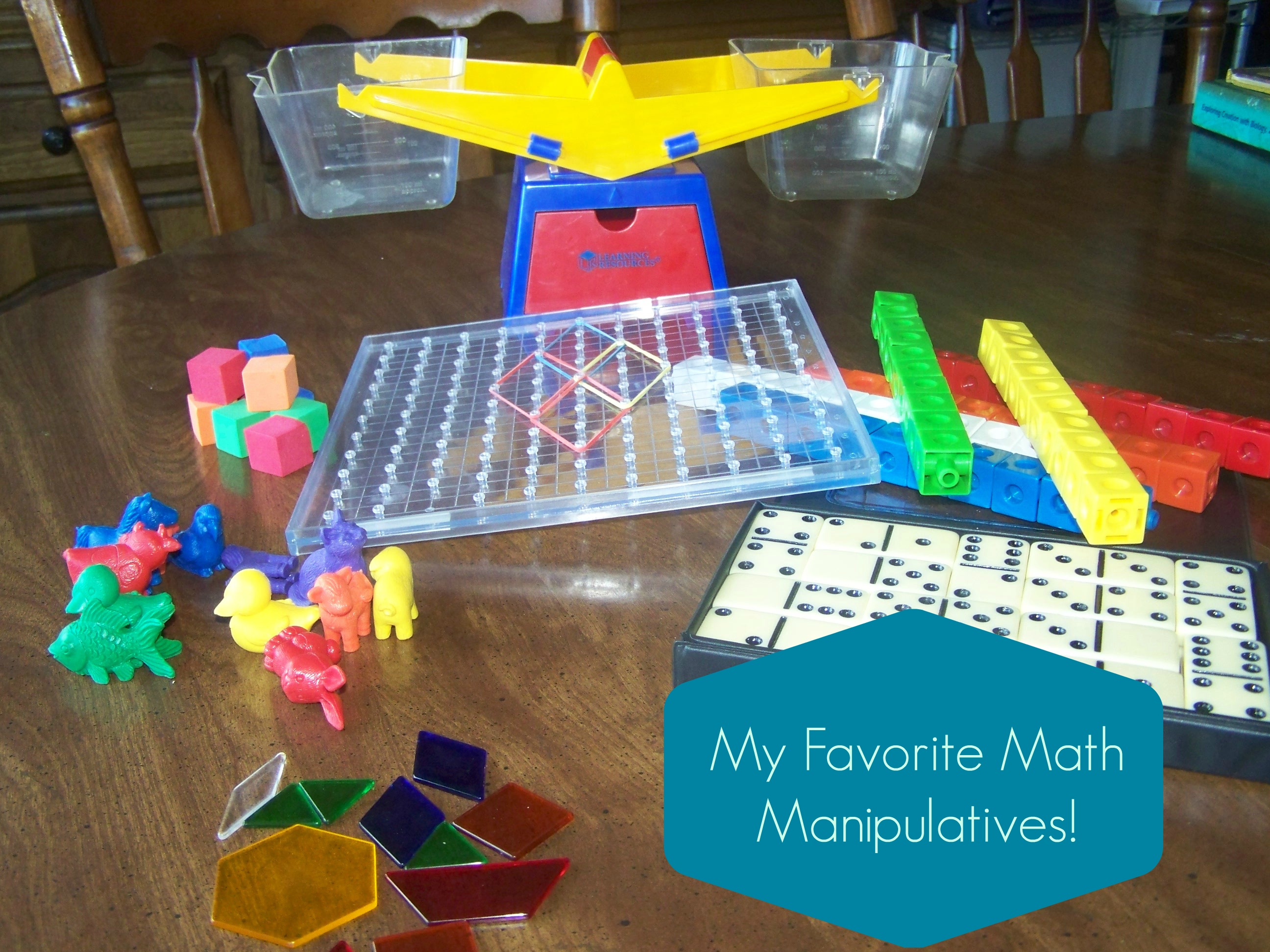 I’ve always believed that early math learning does not require a formal math curriculum. When my children were young, we had lots of fun exploring math concepts through manipulative play. Let me share a few of my favorite math manipulatives.
1. Every homeschool math explorer needs a balance. With simple play, understanding of the concepts of balance, heavier, lighter, more, less and even will easily become clear. Most of my other favorite manipulatives have been weighed in this balance.
2 & 3. Colorful counters. The foam cubes(2) were purchased in a large pack for a dollar a great value! I’ve also seen wooden ones that are very nice. The rubber animal counters (3) are just plain fun. A set of counters is great for weighing, patterning, matching, one-to-one correspondence, sorting/classification and beginning addition/subtraction.
4. Geoboard. Creating designs on a geoboard requires more critical thinking than one may realize. I’ve noticed that even my middle & high school aged children have not outgrown enjoying our set of geoboards.

5. Pattern blocks. I inherited these transparent pattern blocks from a teacher friend many years ago. These are invaluable! You can find lots of great pattern block printables that your children will enjoy for many years.
6. Dominoes. You can make up matching games using dominoes, work on one-to-one correspondence and practice beginning addition. Don’t forget to line them up and knock them over!
7. Connecting cubes. These are my favorites for patterning, non-standard measurement and learning to count by fives and tens.
Looking to add to your collection of math manipulatives? Try checking the dollar store and used homeschool materials websites. Also, try searching for “printable math manipulatives” – there are lots available. If you have a handy/crafty friend or relative, they can make you a set of wooden counters, as well as a geoboard.
Do you have some math manipulatives that are your favorites? Leave a comment and tell me about how you use them in your homeschool.
Is Water In Your Homeschool Routine?
 I have been thinking about how I, myself, struggle with drinking enough water during the day. I wasn’t raised to consider that drinking water is a priority that we need to keep tabs on in our life. I was like the sheep led to water once a day and I began to think that drinking water was just something you did when you had a break and you had nothing else to do. I realized now that as I am trying to really work at this habit and how hard it is for me, that I’d really like my kids to have it easier. I want them to drink water automatically more out of habit, other than because they have a headache or some other water related problem.
During this last year, I’ve done a lot of thinking about my health. I wasn’t horribly unhealthy, but I started having a few health issues. I’d go to the doctor and everything related to my issues came up normal. Strange. My husband did some reading and laughed and said, “It is your bad habit, you need to be drinking more water.” I realized, too, that I have 3 of my 5 children that do not like to drink water, either.
Now, it isn’t like I have not tried to drink water, I just don’t think about drinking water. I prayed and realized I needed to be more diligent about it. I need to make deliberate choices, otherwise I am simply too busy for it to happen.
I wanted to share a couple reasons why drinking water is important for us as homeschoolers. Our body is made up of over 70% water. Our brain alone consists of about 85% water. Water can prevent issues such as ADD and depression. Water helps you think faster and helps you to be more focused. You will also experience greater clarity and creativity in your thinking. If you want to learn more, you can go to this website, Water Benefits Health,and read more, or simply search about water and the body’s needs.
If keeping hydrated is more than just flushing toxins out of our body, but part of helping us to learn better, we really need to keep on this and be deliberate in our choices of drinking water! Now, I knew all this. I’ve learned it in my nurse’s training, I’ve taught it to many during health seminars at church, it’s part of the NEWSTART principle we often hear about. But that didn’t help me “do it”. I needed to sit down and actually figure out how to conquer my bad habit of not drinking enough water. I also needed to figure out how to teach my kids to do the same, so that they would find learning more fun and less frustrating.
There are various rules for how much water you should be drinking. Some say 8 – six ounce glasses a day, some say 8 eight ounce glasses a day. Others say ½ ounce per pound of body weight per day, and still others say if you are active it should be 2/3 ounce per pound of body weight. Whatever rule of thumb you use, if you are getting less than 4-6 glasses of water a day, I think it is important for us to up our intake. This would actually make a good math and health lesson one day to actually figure out how much water you and your kids each need to drink and then figure out a plan to get it done.
I’m in the process of tweaking our plan right now, and thought that maybe you all might want to join our family as we seek to increase our water intake so that our brains will function to the best of their ability by giving them the water they need to work properly.
Feel free to share in the comment sections, ideas that work for your family to get all that water in each day. I’m sure it will help others that are struggling to find a way to make it work for them!
SonLight Education Ministry Download #5 Now Available
Download # 5 includes Year 2 Quarter 4 of the Family Bible Lessons; the rest of lessons 7-8 in the 2-8 program, and the 23 Psalm for Children Reader. Click HERE to go directly to the SonLight download page for links and instructions.

The October 2013 Newsletter has more detailed information if you need assistance.
 The Adventist Home Educator