
How fun! Animal alphabet coloring pages – great for learning letters or an animal-themed study. Lots of possibilities. Click on the image or HERE to find these great printables.
How fun! Animal alphabet coloring pages – great for learning letters or an animal-themed study. Lots of possibilities. Click on the image or HERE to find these great printables.
“If you are the age where you are beginning to read… You’re not just learning to read so that you can read stop signs… Reading the Bible is the most important thing you can be reading.” Pastor Joe Reeves, Day 1 of Week of Prayer
Here are some free copywork pages to help the younger children in learning their weekly memory verses that correspond with their Sabbath School lessons for this quarter.
My Bible First, Year A, Quarter 1, Memory Verses

Source: sunhatsandwellieboots.com
Upcycled story magnets- what a great idea! Old or torn picture books and old Sabbath school papers are excellent sources for pictures. This is a great way to occupy little ones while you are working with older children. Ask a child to arrange the pictures to suit them and then tell you a story- you’ve just worked on some great literacy/pre-writing/early composition skills. Fun!
Click on the image or the source link to get details on how to make story magnets.
Here’s a fun way to add a kinesthetic (hands-on) element to learning the alphabet. Click on the image or the source link below to connect with these fun free printables. Don’t have pattern blocks? You can print these on sturdy paper, cover with contact paper and have some fun!

Source: confessionsofahomeschooler.com
The mind assimilates to that which it feeds upon. The secular papers are filled with accounts of murders, robberies, and other revolting crimes, and the mind of the reader dwells on the scenes of vice therein depicted. By indulgence, the reading of sensational or demoralizing literature becomes a habit, like the use of opium or other baleful drugs, and as a result, the minds of thousands are enfeebled, debased, and even crazed. Satan is doing more through the productions of the press to weaken the minds and corrupt the morals of the youth than by any other means.  Let all reading of this character be banished from your houses, let books that are useful, instructive, and elevating, be placed in your libraries and upon our tables, with the Review and Herald, our church paper, and the Signs of the Times, our missionary paper, and the effect upon both parents and children will be good. During these long winter evenings, let parents see that all their children are at home, and then let the time be devoted to the reading of the Scriptures and other interesting books that will impart knowledge and inculcate right principles. Let the best reader be selected to read aloud, while other members of the family are engaged in useful occupations. Thus these evenings at home may be made both pleasant and profitable. Pure, healthful reading will be to the mind what healthful food is to the body. You will thus become stronger to resist temptation, to form right habits, and to act upon right principles.
The Review and Herald, December 26, 1882.
Do you have the Uncle Arthur Bible Story books? Here’s a great free resource to accompany the series. This two-part curriculum is designed for classroom use, but is a great source of ideas for creative worships and Bible lessons. It is designed to be an 8 year program. The links are below in bold.

DOWNLOAD NOTE: The documents are large, the first set is 293 pages!
This South Pacific Division elementary Bible curriculum was developed by and for Pacific Island Adventist schools. This teacher’s guide includes lesson or story plans to accompany Uncle Arthur’s Bible Story series, Volumes 1-6. Concise, clear, adaptable, utilizing multiple intelligences, this Adventist religious education resource is free of copyright, ready for use or translation. See also the companion Pacific Island Bible Story Plans 7-10
CURRICULUM REVIEW – THE MYSTERY OF HISTORY by Linda Lacour Hobar
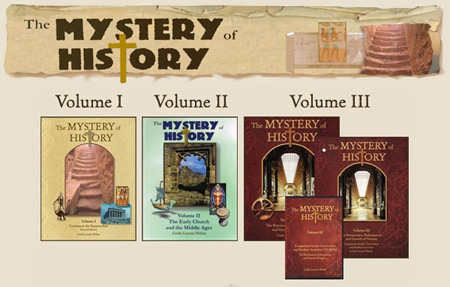
The Mystery of History is a three, soon to be four, volume series that combines world history and Biblical history in a chronological format. For example you will read the lesson about Joshua, Jericho and Rahab (1470 BC) right before the lesson on King Tut (1333 BC) and realize that Joshua and King Tut lived only a few decades apart. The curriculum is designed for use with 3rd-8th graders, but there are adaptations for older and younger students so you can use it to teach all of your children one history lesson together.
The volumes cover the following:
Volume I – Creation to the Resurrection
Volume II – The Early Church and the Middle Ages
Volume III – The Renaissance
Volume IV – Revolutions and Rising Nations (In progress, not yet completed.)
At the beginning of each quarter there is a summary of events around the world to introduce you to the time period you will be studying. Your students will begin each week with a very short What Do You Know? Pretest. This exposes them to new terms that they will be studying and is designed to pique their curiosity. Pretest grades aren’t recorded.
There are about 100 lessons in one volume and the author recommends doing three lessons per week if you are following a traditional 36 week school year. The lessons are written at about a 6th grade level and can be read by the student, by the teacher or both.
After every lesson there is an activity section where the activities are broken down into age groups of Younger Students, Middle Students and Older Students. The activities are designed to reinforce the material from the lesson and help them retain what was learned. There is often more than one activity listed and you can pick and choose to find one that suits your child’s learning style. The students also make memory cards as they go along to reinforce what they’ve learned.
At the end of every third lesson there is a review, a time line activity, some map exercises, and a quiz. At the end of each quarter there are quarterly work sheets to help students sum up what they’ve learned. At the end of each semester there is a test over the previous two quarters.
The book has very detailed instructions on making the memory cards and time line There are also tips on grading. In the back of the book there is a list of books for recommended reading and videos that go along with each lesson. These recommendations are also broken down into categories of the different age groups. There is also an answer key in the back of the book for the exercises, quizzes, worksheets, tests and pretests.
There are several items that can be purchased for each edition. The one that is absolutely necessary is the book. The other items are not necessary, but can be handy. There are audio books available, in CD or down-loadable MP3 format, that read the stories for you. A CD Rom of Printable Reproducibles is available. You can select and print items such as pretests, exercises, quizzes, worksheets, tests, and outline maps, as well as items from the appendices. Without this you would be photocopying from the book itself. There are several other items available that you can find at the Mystery of History website – http://www.themysteryofhistory.info/index.shtml – such as a time line sets, lapbook kits and coloring pages.
SDA NOTES
You will occasionally come across a lesson that we, as Seventh-day Adventists, see in a different light. It is easy to just skip reading that lesson & present it from an Adventist perspective. For example, Constantine is presented in a favorable light for making Sunday a holy day. Obviously we have a totally different opinion on Constantine. I showed the Constantine section from the video The Seventh Day to cover that lesson. The lessons are short and easy to look over ahead of time in order to catch little things like this.
One thing I think most Adventists will appreciate is how Volume I doesn’t dwell on the myths of the Greek and Roman gods in the way many ancient history books do. While a god is mentioned occasionally in the context of the lesson, your children won’t be studying them. For example the lesson on the Olympic games mentions that the women’s games were named after the goddess Hera. That’s it. There was no background on the myths of Hera at all. Just a brief mention of her name. The lesson on Stonehenge avoided the pagan religious associations and brought out that nobody really knows why it was built. It mentions several possibilities and focuses on how it might have been built instead of the why.
In Volume II you may want to cover a few of the lessons in a different way or skip them. Examples would be The Apostles Creed, stories about different “saints”, legends of King Arthur and Beowulf. My son was Junior High age when we covered this and I chose to go over the lessons and discuss them from an Adventist perspective.
I personally didn’t find anything in Volume III that I felt I needed to approach in a different way. Even if you do, it is very easy to skip or change the presentation of the lesson in question. As of now Volume IV isn’t finished yet, but I feel confident that it will be in the same format and easy to adapt.
MY THOUGHTS
Personally, I absolutely loved this curriculum. My son didn’t like history until we started using The Mystery of History. We were both so disappointed that Volume IV didn’t come out in time for him to use it for 9th grade. Here are the things I like most about it:
I will warn you that the first time I picked this up at a curriculum fair it was so overwhelming that I didn’t buy it. I thought it looked like too too much work. When I went back the next year I look at it again, came home and read some reviews and decided I would give it a try. I’m so glad I did. Just remember when you’re using it that you don’t have to do everything recommended. This is a curriculum that is meant to be adapted to your family and lifestyle. It’s not meant to rule over you and bog you down.
Review by Susie S.
Now it’s your turn. You can rate this product by hovering over the stars below. Please feel free to add additional comments that may be helpful for others in making a decision towards using this product.
We appreciate those that are helping with curriculum reviews. If you’d like to help out by writing one or more reviews, please email Melissa at adventisthomeducator@gmail.com
 The Adventist Home Educator