Curriculum developers are excellent in marketing, and homeschool parents are a wide open market for their wares. Wanting only the best for their children, homeschool parents are willing consumers of these goods. But, remembering that less is more and to keep it simple are concepts that are worth considering. A successful homeschool curriculum does not depend upon a plethora of textbooks and copy work. Instead, a few simple tools and a daily routine can go a long way in establishing a homeschool curriculum that is custom designed for each child in your family.
When shopping for your homeschool curriculum and resources keep in mind the counsel we’ve been given.
“During the first six or seven years of a child’s life, special attention should be given to physical training, rather than intellect… Up to this period children should be left, like little lambs, to roam around the house and in the yards, in the buoyancy of their spirits, skipping and jumping, free from care and trouble.” Child Guidance, p. 300
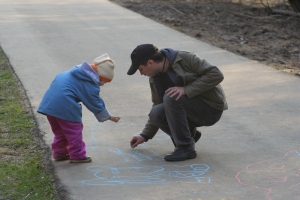
“For the first eight or ten years of a child’s life the field or garden is the best schoolroom, the mother the best teacher, nature the best lesson book.” Education, p. 208

In light of this, buying expensive homeschooling materials for your little ones really isn’t necessary. Does that mean that you’re not to teach them anything? Not at all! Let’s look at a few ways to cover the basic subjects in a relaxed, yet effective way.
*Bible – Starting the day with family worship sets the tone for a successful day. Beginning a habit of daily devotions with your children will develop into their own devotions as they grow older. Study the Sabbath School lesson. Read through The Bible Story books. Listen to The Bible in Living Sound. Start a prayer, praise & thankfulness journal. Sing songs of praise. Read stories that will help develop good character traits in your children. Memorize Bible verses.
*Reading – Start reading aloud to your children when they are very young and never stop. Children of all ages, even teens, enjoy listening to stories read aloud. It’s a wonderful opportunity for quality family time. Read Bible stories, nature stories, history books, biographies, human interest stories, poems and anything else your children find interesting.
As children start to grow, show them sounds, words, letters, etc. as you read. Have them share/read words, then sentences and paragraphs during your reading times together. When they are mature enough, find a simple, low pressure reading program. The program doesn’t need to be complicated or costly. Just take it slow. Children will learn to read in their own time. Right now your goal is to develop a love for reading so they will want to do it on their own.
*Nature & Science – We are told nature is God’s second book. Go for nature walks, and get fresh air and exercise daily. During your walks collect and identify wild flowers, plants, insects, trees, birds, etc. Record your discoveries in a nature notebook. Invest in some field guides. Read and learn about nature during your family reading time. Draw, paint and write about what you see in nature.
*Math – Preschool and elementary math can be taught by matching socks, counting items, and sorting them into groups. Teach fractions in the kitchen by cutting apples, oranges, or pies, measuring ingredients. Learn measurement in Dad’s wood shop measuring, cutting and building. Use number lines to learn to add and subtract in a visual way. Toy cars can travel along the line for so many miles, then drive back so many more to find totals and differences. Use flash cards and addition and subtraction practice sheets to help them learn their math facts. Do short timed drills. As they mature and gain understanding add an occasional math workbook page if the children enjoy them.
Middle school and high school math will require a textbook, but don’t eliminate drill and parental time. Give opportunity for drill and review; not going at too fast a pace. Learn for mastery.
*History, Geography, Social Studies, Language Arts – These subjects can be implemented through the above activities and through the unit study method below. It’s so easy to incorporate them into unit studies and family reading time. Purchase a good English handbook to help guide you in introducing proper grammar, and correct punctuation and capitalization. Invest in a spelling program that grows with the student and will cover several grade levels. Find free spelling lists and games online.
*Unit Studies – The easiest way to learn is by combining all the subject areas while learning one topic. This is called a unit study. Always have a unit study going as a part of the school day. For example, if a child is interested in airplanes read stories about flight (the Wright brothers, mission pilots, early air mail flights, WW II pilots; etc.). Research in books and online about types of planes. Go to the airport and identify planes. Draw planes and cross-section views of their mechanical parts. Analyze differences in the time it takes to drive or fly to the same destination and chart routes. Build model airplanes. Write or dictate a story about a plane and/or pilot. Take advantage of free airplane rides offered by many private pilot clubs. Take pictures of planes and make a scrapbook or write a story. Journal about planes. Buy magazines about planes and have child read aloud to siblings. See if a private pilot needs help maintaining a plane (washing, checking tires, etc.). Go to a flight museum or an air show. Get a book about making paper airplanes and try making different kinds. Compare and contrast their flights for speed, distance, and acrobatic skills. Develop a rating chart. Go with the flow and what your child shows an interest in. Do you get the idea? Every subject that interests your family can be studied in this manner!
Don’t forget two other important aspects of your custom designed homeschool curriculum.
*Work – It’s important for children to learn that in a family we all have responsibilities that help the household run smoothly. Assign each child household chores that are appropriate for their age and ability. Teach them gently and thoroughly how to complete their tasks. Show the older children how to help the younger ones.
*Service – Your children will benefit immensely from learning to put others first through service activities. Start first by looking for service opportunities in your own home. Find ways to serve one another, grandparents, and other family members. Then branch out to serving others in your neighborhood, church, and community.
As your children grow and mature you can add an appropriate textbook here and there where necessary. A well-rounded combination of unit studies, a few carefully chosen textbooks, reading individually and aloud as a family, a computer and a good library for research, hobbies, nature study, and family worship will prove to be the very best curriculum available for your homeschooling family.






 The Adventist Home Educator