Motivation Monday

“Children as well as parents have important duties in the home. They should be taught that they are a part of the home firm. They are fed and clothed and loved and cared for, and they should respond to these many mercies by bearing their share of the home burdens and bringing all the happiness possible into the family of which they are members.”

Ministry of Healing , 394

Motivation Monday

“The fact that he [Christ] was without fault in his home life makes him a pattern for all children and youth. He was no less the Son of God in his quiet life at home, in faithfully serving his parents at Nazareth, than while healing the sick, and in raising the dead.

“Important lessons can be here drawn for children and youth, that they cannot be employed in a more noble work than in performing their duty to their parents. They are no less engaged in the work of God, acknowledged and recorded by the heavenly angels as such, in faithful, filial obedience, than in a more public and more responsible position of later days. Youth can serve God as faithfully in the submission of their wills to their parents, and in the filial discharge of the every-day duties of life, as in the house of God.”

Youth’s Instructor, March 1, 1873

Seeds + Dirt =

Seeds + Dirt = the beginnings of a great nature study!

 You will find that even  very young children love the idea of helping to grow a plant.   There are lots of options for learning how a seed becomes a plant.   A wet paper towel inside of a sealed sandwich bag is a fun way to watch a seed sprout.   A small pot with soil will create great interest as your child waits for the seed to pop through the soil.  Quick germinating seeds like radishes, melons, or lettuce will be exciting to wait for.   If  you have the space outdoors, a  manageable-sized vegetable or flower garden for the entire family to enjoy is a worthwhile project.

Dropping a seed into soil is more than just a fun school project.  There are valuable character lessons for your children to to learn: responsibility, diligence, perseverance, and more.

“The parable of the sower and the seed conveys a deep spiritual lesson. The seed represents the principles sown in the heart, and its growth the development of character. Make the teaching on this point practical. The children can prepare the soiland sow the seed; and as they work, the parent or teacher can explain to them the garden of the heart, with the good or bad seed sown there; and that as the garden must be prepared for the natural seed, so the heart must be prepared for the seed of truth. As the plant grows, the correspondence between the natural and the spiritual sowing can be continued.”

Child Guidance, 56

Here are a few links to give you inspiration:

My First Garden

Nature Garden Activities

Children in the Garden

Planting a Garden with your Child

Motivation Monday

“One of the surest safeguards against evil is useful occupation, while idleness is one of the greatest curses; for vice, crime, and poverty follow in its wake.”

Counsels to Parents, Teachers and Students, 275

Samuel, the Diligent Worker

“The child Samuel grew on, and was in favor both with the Lord, and also with men.” “It was his constant endeavor to become what God would have him. This is the privilege of every youth. God is pleased when even little children give themselves to His service.” (1 Samuel 2:26; Patriarchs and Prophets, 573)

What a thought to encourage us to work for the conversion of even our little ones. Now we must put our faith into actions and work for their salvation. It is quite interesting how we are counseled to prepare our children to be useful agents of the Lord in this life. We are counseled to teach our children how to work—how to be diligent workers. We can learn the blessing that work is for children in so many stories and one of those is the story of the child Samuel. “Young as he was when brought to minister in the tabernacle, Samuel had even then duties to perform in the service of God, according to his capacity. These were at first very humble, and not always pleasant; but they were performed to the best of his ability, and with a willing heart. His religion was carried into every duty of life. He regarded himself as God’s servant, and his work as God’s work. His efforts were accepted, because they were prompted by love to and a sincere desire to do His will. It was thus that Samuel became a co-worker with the Lord of heaven and earth. And God fitted him to accomplish a great work for Israel.” (Patriarchs and Prophets, 573)

Can we train our children to be faithful like Samuel? Can we train them to cheerfully carry their lot in life, no matter what their age? Can we train them to regard work as service unto the Lord? “If children were taught to regard the humble round of everyday duties as the course marked out for them by the Lord, as a school in which they were to be trained to render faithful and efficient service, how much more pleasant and honorable would their work appear. To perform every duty as unto the Lord, throws a charm around the humblest employment and links the workers on earth with the holy beings who do God’s will in heaven.” (Patriarchs and Prophets, 574)
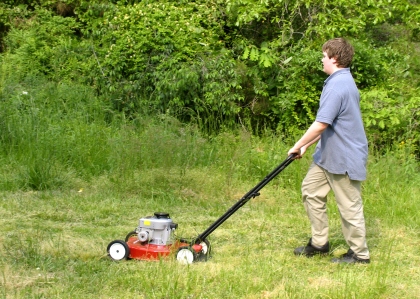
Sometimes it’s difficult to train children to work. Sometimes it’s easier for parents to just do the work themselves. Why should we put so much effort into teaching them how to do their work with thoroughness and diligence? “Success in this life, success in gaining the future life, depends upon a faithful, conscientious attention to the little things. Perfection is seen in the least, no less than in the greatest, of the works of God. The hand that hung the worlds in space is the hand that wrought with delicate skill the lilies of the field. And as God is perfect in His sphere, so we are to be perfect in ours. The symmetrical structure of a strong, beautiful character is built up by individual acts of duty. And faithfulness should characterize our life in the least as well as in the greatest of its details. Integrity in little things, the performance of little acts of fidelity and little deeds of kindness, will gladden the path of life; and when our work on earth is ended, it will be found that every one of the little duties faithfully performed has exerted an influence for good–an influence that can never perish.” (Ibid.) God appointed work as a blessing, and only the diligent worker finds the true glory and joy of life. (Desire of Ages, 72)

Wouldn’t it be wonderful to prepare our children to be Samuels? It’s possible and it’s needed. “The youth of our time may become as precious in the sight of God as was Samuel. By faithfully maintaining their Christian integrity, they may exert a strong influence in the work of reform. Such men are needed at this time. God has a work for every one of them. Never did men achieve greater results for God and humanity than may be achieved in this our day by those who will be faithful to their God-given trust.” (Patriarchs and Prophets, 574.)

As we’re planning out our children’s learning for the next day, week, month or year, let us not forget to include learning to work. We want our children to be successful in this life and the life to come.

Is Folding Laundry in Your Lesson Plans?

Training children to be helpers at home lightens the mother’s load as well as teaching children responsibility and diligence.

It can be overwhelming; a home to care for, meals to prepare, laundry, errands. Then there are the children that you feel convicted to educate at home. How do you get it all done?

You don’t. Meaning, YOU- the mother, should not bear the burden of “getting it all done” alone. Children are the junior partners in the home, and as such, must learn to take on a portion of the responsibility of keeping the family firm running smoothly.

God wants the children of all believers to be trained from their earliest years to share the burdens that their parents must bear in caring for them.” AH, 238

We as parents take great care in planning an excellent curriculum for our children, but often forget an important detail: True Education involves not only the head, but also the hands. Teaching our children to participate in the running of the household is just as much a part of True Education as is scripture memory, or nature study or mathematics.

Children and youth should take pleasure in making lighter the cares of father and mother, showing an unselfish interest in the home. As they cheerfully lift the burdens that fall to their share, they are receiving a training which will fit them for positions of trust and usefulness. Each year they are to make steady advancement, gradually but surely laying aside the inexperience of boyhood and girlhood for the experience of manhood and womanhood. In the faithful performance of the simple duties of the home boys and girls lay the foundation for mental, moral, and spiritual excellence” AH 288

Is there a simple task that your younger child could do with a little training? Sweeping, folding laundry, collecting the trash? What simple meal that your older child could learn to prepare independently? Do your children rinse their own plates and stack them in the dishwasher after each meal? Have you taught ironing so that your child can prepare everyone’s clothes for Sabbath?   As you consider your lessons for the coming weeks, remember to include lessons on appropriate homemaking skills for your children. True Education is educating the whole child.

The Saviour’s early years were useful years. He was His mother’s helper in the home; and He was just as verily fulfilling His commission when performing the duties of the home and working at the carpenter’s bench as when He engaged in His public work of ministry. In His earth life Christ was an example to all the human family, and He was obedient and helpful in the home. He learned the carpenter’s trade and worked with His own hands in the little shop at Nazareth…. As He worked in childhood and youth, mind and body were developed. He did not use His physical powers recklessly, but in such a way as to keep them in health, that He might do the best work in every line.” AH, 290

The Fruit of Idleness

This  parent-teacher conference was to discuss a particular young man who sullenly dragged himself into class each day as if it were a terrible inconvenience.  Every day he sat in his desk without opening a book or lifting a pencil.   As was her custom, the school counselor started the meeting by asking the mother to share about the young man daily life at home.   The counselor asked if the young man had any chores or work responsibilities at home.  No, the mother responded, he was not expected to do any chores at home.  Not even take out the trash?  The mother responded that she took out the trash, and did not ask him to do anything in the way of work around the home.  With that response, the school counselor stood up, declared that the conference was over and that  all of the teachers could leave the meeting.    Incredulous,  the mother asked why.  I’ll never forget the counselor’s response:

“If you have never taught him to work at home,

  how do you expect that we will get him to work at school?”

“He doesn’t even take out the trash?”

Of all of the parent conferences I attended in my years as a classroom teacher, that particular conference will forever stand out in my mind.   The look on the poor mother’s face as she realized her mistake!  Thankfully, the counselor sat back down to discuss with the stricken mother ways to begin to solve the problem.   As I left that conference, I was convicted anew of  the eternal  importance of teaching children the value of work.   Now, as parent-teacher to my own children, teaching habits of industry is a vital part of my True Education goals.

“Parents cannot commit a greater sin than to neglect their God-given responsibilities in leaving their children with nothing to do; for these children will soon learn to love idleness and grow up to be shiftless, useless men and women. When they become old enough to earn their living and are taken into employment, they will work in a lazy, droning way and will think they will be paid just the same if they idle away their time, as if they did faithful work. There is every difference between this class of worker and the one who realizes that he must be a faithful steward. In whatever line of work they engage, the youth should be “diligent in business, fervent in spirit, serving the Lord”; for he that is unfaithful in that which is least is unfaithful also in much.”

Child Guidance – 122,123