Animal Encounters Series

Have you heard about Animal Encounters?  It’s a new documentary series produced by the Seventh-day Adventist Church.  Here’s a description: “Animal Encounters is a new, exciting nature documentary hosted by three women: Gabi from Germany, Kezia from Kenya and Cassila from Brazil. In each episode they share their personal experiences as they encounter God’s creation…” You can watch the episodes online HERE.

Snowflake Unit Study

snowflake unit studyA snowflake unit study is a fun way to add interest to cold, dark winter days.   Here are some ideas/links to get you started.

Start your snowflake learning with Wilson “Snowflake” Bentley, a self-educated farmer who became a pioneer in the field of photomicrography, photographing more than 5000 snow crystals.

TeachWithMe.com features a free snowflake alphabet printable perfect for phonics practice and word games.

Grab that bucket of melty beads and make snowflakes!  Since you need only the white ones, start out with a sorting game.

Coffee filter snowflakes are always fun.

Check the bookshelves at home and the library for snow/winter themed books to cuddle up and read together.   HomeschoolShare has some great book-based lapbook & notebook printables and activities to supplement your reading.

It’s always snowing on SnowDays!  This site is addictively fun!

Boy’s Life shares a way to catch a snowflake and keep it forever.  Older children may enjoy this more involved project.

Cal Tech has a great site that delves into the science of snowflakes and snow crystals.

How do snowflakes form?  The NOAA can tell you. snowflake 2 unit study

Khan Academy adds some math learning to snowflakes via video.

Start with an equilateral triangle.  Follow the directions carefully and you will have created a Koch snowflake and learned about fractals all at the same time!

Wrap up your snowflake unit by learning the hymn Whiter Than Snow.

Nature Study with Older Students

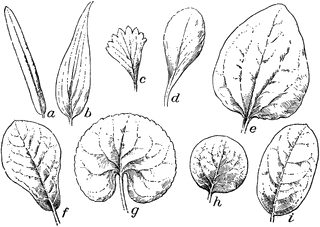
leaf shapesThinking about nature study with your teenagers?   Here’s a link with some helpful ideas and links to keep both you and your teens motivated.

Nature Study Ideas For Teens


Science Ideas for Grades 7-12

Looking to add interest to your middle/high schooler’s science curriculum?  Here are a few Pinterest ideas that we’ve posted lately.

Great Resource ~ Science at Home Video Series

The temperatures have been over 100 degrees where I live, so incorporating six water experiments and activities into my lesson plans sounds like a very, very good idea!     How about a fun video hangout to get the learning started?

Water-ExperimentsInspiration Laboratories is the host of the Science at  Home Video Series.  Click on the image above or the link to go directly to the site.  You will be inspired!

Great Resource ~ Middle School Science

logoMiddle School Science is a site filled with ideas , lesson plans and activities for middle school-level science study.  Click on the logo or the link to find this great resource.

Journey North: Nature Study via Migration Patterns

For those of you with children that are naturalists at heart, this might be the foundation of a great season-long unit study.   Since it is based on Spring migration patterns, NOW  would be a good time to examine the materials carefully to see if  they will work for your family.

Program Description:

“Journey North engages citizen scientists in a global study of wildlife migration and seasonal change. K-12 students share their own field observations with classmates across North America. They track the coming of spring through the migration patterns of monarch butterflies, robins, hummingbirds, whooping cranes, gray whales, bald eagles— and other birds and mammals; the budding of plants; changing sunlight; and other natural events. Find migration maps, images, standards-based lesson plans, activities and information to help students make local observations and fit them into a global context. Widely considered a best-practices model for education, Journey North is the nation’s premiere citizen science project for children. The general public is welcome to participate.”

Source: learner.org via Ann on Pinterest