Thanksgiving Lapbook

Thanksgiving is coming, ready or not! Thanksgiving is a very fun time to do a unit study with homeschoolers. Learn about the Pilgrims, about religious liberty, about the northeast Indians, about harvest. There are so many aspects to choose from. Here are a few ideas of books to read and ways to put together a lapbook about Thanksgiving.

Some fun reads for children are Squanto And The Miracle Of Thanksgiving, Stories of the Pilgrims, The Thanksgiving Story, If You Were at the First Thanksgiving. and If You Sailed on the Mayflower in 1620.

If you would like to make a Thanksgiving lapbook, you can get some very nice printable mini books from the books History Pockets, Life in Plymouth Colony and Easy Make and Learn Projects: The Pilgrims, the Mayflower and More. You can also find some things that could be used in a lap book and some fun crafts for Thanksgiving at Danielle’s Place and at Enchanted Learning.

Here are some pictures of Thanksgiving lap books by some of our very own AHE children:


You can see close ups of this lapbook  by clicking here.

You can see closeups of this lapbook by clicking here.

Have preparing for Thanksgiving!

Free SDA Resources to Use in Your Homeschool

Here is a list of free SDA resources that you can use/adapt to fit the needs of your homeschool program.   This is not a comprehensive list,  so look for a new list with even more resources coming soon!


Bible/Church History/SDA pioneers

God’s Messenger – Lesson plans and mp3s on SDA pioneers.

Youth Bible Reading Plan – A four year Bible reading plan for young people.

The Bible Story lesson plans Volumes 1-6 and Volumes 7-10. – From the South Pacific Division, lesson plans to accompany the “blue books” that so many of us have on our bookshelves. Download Note: the documents are large!

Planning a study of Adventist pioneers ? This gallery of drawings of Adventist pioneers will be helpful to your study. Adventist Pioneer Library has a nice page with brief biographical sketches and pictures as well. If you are also creating a time-line of church history, here’s a sample parallel timeline showing key events in US history, world history and SDA church history. Makes a great model to help your student create their own parallel time-line.

Free study guides for 22 E.G. White books.

History/Geography/Missions/Biographies

Maranatha Volunteers International – Lots of inspiration for hands-on mission work.  Free DVDs available.

Adventist Missions– Lots of ideas and resources.  Be sure to check the past children’s quarterlies for games, puzzles and recipes.

Adventist Frontier Missions– Inspiring first-hand accounts of reaching the unreached.

CIRCLE : Browsing Adventist Missions – A page full of Adventist mission websites and resources.

Visionary for Kids – Online kids magazine issue focusing on Adventist missions.


Unit Studies

Adventurer and Pathfinder awards make great outlines for creating fun unit studies.

Adventurer Club Awards- Award requirements

Adventurer Awards Wikibook Helps for completing awards.

Pathfinder Club Honors Honors requirements

Pathfinder Honors Wikibook Helps and answers for honors


Fun Links for August

When you are first introducing your child to letter and number awareness, it is nice to have a variety of resources at your disposal. Here is a great set of links- pick and choose the resources that meet your child’s learning style and academic maturity. You will find songs, games, lapbooks, printables and more. Enjoy!

Alphabet Awareness

Alphabet Avenue – tons of ideas that you can glean from to personalize you child’s learning.

PreKinders – one of my favorite sites for printables and hands-on activities.

Crayola – fun printable coloring sheets.

MrPrintables.com– Alphabet flashcards, both plain and fancy.

Totally Tots– crafts for every letter of the alphabet, perfect for a hands-on learner.

 Number Awareness

Learningpage.com -free membership gets you a set of nice number writing practice sheets (scroll down to the bottom).

Playful Learning– hands-on math learning experiences.

Homeschool Creations– scroll down to find my favorite, the printable playdough mats.

Homeschool Share – a very simple lapbook showing 1-10.

PreKinders – more easy-to-put-together activities teaching numbers and counting.

Bible Memorization Motivation

  A few weeks ago we were privileged to participate in a Bible Memorization Seminar in our area.  The four Nebblett siblings came fromNew Mexicoto teach and train on this and other spiritual topics.  What a blessing!

As a child, my brain memorized pretty fast.  I remember earning a beautiful new Bible for memorizing a large number of verses one time.  The verses I learned then have stuck with me, at least in part, until this day.  But the verses I’ve worked on in the last couple of decades are only there in general meaning, or paraphrase.  The older I get, the harder it seems to be to memorize, so sadly, I have kind of given up on memorization, making excuses, like I’m too busy to do that right now. 

I thought the seminar would be really good for my kids, motivating them to make the best of their brain while it is young, but I found it was very helpful for me too.
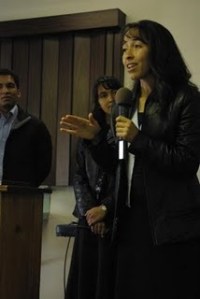
 

Our guest speakers are all in their 20’s.  They come from the same family, but they have different personalities, and learning styles.  They have figured out that they all memorize best a little differently.  One is more auditory, saying the verses out loud, or listening to them.  One is more visual, reading the verses, and remembering how the verse looks on the page.  One is more creative, drawing stick figures to help illustrate the verses.  One like to be more active when memorizing.

Here are some of the points our guest speakers shared with us, taken from their own experience and from a survey they conducted among some other young people.

1.  Don’t try to memorize laying down.  Our cozy warm bed is better for putting us to sleep then memorizing scripture.  It is better to be upright, or even active while memorizing.

2.  Experiment with different ways of memorizing to see which one(s) work better for you.

3.  Try including more then one method of memorization while working on specific verses.

4.  It might help you if you memorize out loud with someone else.

5.  Accountability is very important.  Find a friend to check on you and see if you’ve memorized your verses, and to encourage you to keep working on more.



The most fun aspect of the seminar was when they divided us up into four groups.  Each group was assigned a section of Revelation 22 to memorize.  Then each of the siblings went to one of the groups and worked with them on their verses.  After 15 minutes, the siblings rotated, and the next sibling worked on our verses with us in a different way.  At the end of an hour, I didn’t have my verses completely memorized, but I was well on the way.  Each group then stood up, one group at a time, and recited their section, so the whole chapter of Revelation 22 was recited, in order.  We relied on other members of our group to help us, but all in all, I thought it was a great success, and a thrill to hear the whole chapter aloud.

I have since thought about Bible memorization and my old brain, and realized I am really good at excuses.  Is it impossible for me, at my age to memorize?  No.  I know I could.  I just haven’t put in the time.  Do I want to have scripture in my heart and mind?  Yes, absolutely yes!  I have decided that even if I don’t memorize quickly, that I should keep working on it, because the more I work at it, the more of it I will have in my brain, even if it is just fragments and pieces.  God can use fragments and pieces at the right time to encourage me, or keep me out of trouble.

I am excited to say that after a search of the Internet, I have found something that is helping me memorize much faster.  At Scripture Typer there is free online software to help you practice typing verses until they are memorized.  It is simple, and uses the visual and kinesthetic modalities all at once as you type the verses you wish to memorize.  I have been working on it for a couple weeks now and have to excitedly report that I’ve already memorized Romans 8: 1 – 5.  I know that doesn’t look like much, but it is major progress for me, and I’m working now on verses 6 – 9.  At Scripture Typer you can download the verses you wish to work on, in the Bible version of your choice, and it will keep track of your progress for you, and even give you reminders to go back and review the verses you have worked on in past weeks.  The only draw back is that you must have an Internet connection to use it.  And my only suggestion to make it better, is if you would speak the verses out loud as you type, because then you would be using three learning modalities, and it might even stick a little quicker.

I really encourage young people to memorize all they can, while their brain is still active and quick, but not to give up when it starts showing its age.  I encourage people with middle age and older brains to try again, and not give up.  I think it might even help to keep us younger, and will certainly help our spiritual lives.  I’ve already been blessed by several special new thoughts I’ve gained in my work on Romans 8, and as you can see, I’ve only completed a very few verses.  I’m not going to give up.  And next time you see me, you can quiz me to see if I can remember any of them.

Heartfelt thanks goes to Barbara at A Wildflower Morning for sharing with us this encouraging post.   Originally posted on her blog on 5/16/11.   *All photos in this post by William.

Nature Study Inspiration

Nature Study is mentioned quite often here on Shaping Hearts and Hands.  Nature is a vitally important learning environment, especially for very young learners.  Many families enjoy getting outdoors and seem to naturally pick up on things to explore and do.  Some households are not outdoor-oriented and  getting started in nature study may be harder.  For those who need a bit of inspiration and practical direction in getting started, the Handbook of Nature Study blog is a perfect resource. This fabulous blog by a homeschool mom is one of the best nature study resources you will find on the web.   Using Anna Comstock’s Handbook of Nature Study (available free online) as a foundation, this blog will give you valuable ideas for a weekly outdoor hour as well as seasonal nature challenges and information on creating nature journals. There are lots of great freebies on the sidebar to get you going in the right direction. Now that we are about to experience a change in the seasons, this is a great time to incorporate nature study into your homeschool curriculum.    Exploring the nooks and crannies of this valuable blog will take time, so grab a cup of tea and prepare to be inspired!

Fun with Letter Tiles!

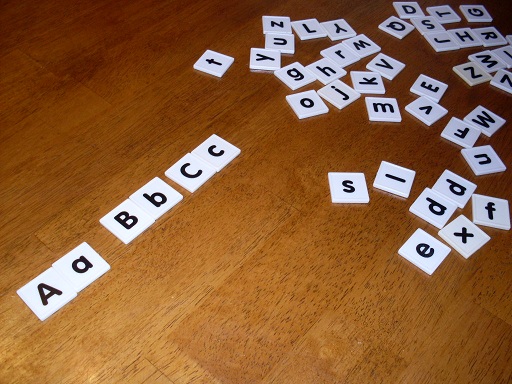
Letter tiles can be a great learning tool for learning the alphabet, the sounds of the alphabet, as well as spelling.  Some activities you can do with your letter tiles are:

Memory Game – Match upper case and lower case letters by placing tiles upside down and taking turns by turning two tiles over each turn.

Matching – Place a group of tiles of matching letters; example:  t, t, a, a, p, p, b, b. Have child match pairs.

Letter Name Game – Say the letter name and have child find the letter from a selection of tiled letters.

Letter Sound Game – Speak the sound of a letter and have child find the letter from a group of tiled letters.

Spell Names – Spell the names of family members and friends.

Spell simple words (or more complex words, as skill develops) – this can be done by choosing an ending such as “-at” and having the child put different beginning sounds to create new words (word families).

Here are a couple websites for creating some matching activities to use with your letter tiles:

Letter Tile Mats (beginning recognition activities for identifying letters and sounds)

Blank Letter Tile Cards (concept similar to Boggle Jr, but you get to choose the words)

Enjoy some fun activities learning with your child.  If you think of additional ideas that Letter Tiles can be used, please comment and share with us (and each other)!

Seeds + Dirt =

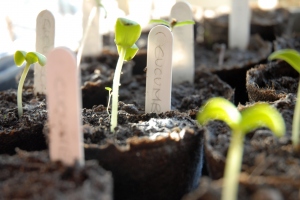
Seeds + Dirt = the beginnings of a great nature study!

 You will find that even  very young children love the idea of helping to grow a plant.   There are lots of options for learning how a seed becomes a plant.   A wet paper towel inside of a sealed sandwich bag is a fun way to watch a seed sprout.   A small pot with soil will create great interest as your child waits for the seed to pop through the soil.  Quick germinating seeds like radishes, melons, or lettuce will be exciting to wait for.   If  you have the space outdoors, a  manageable-sized vegetable or flower garden for the entire family to enjoy is a worthwhile project.

Dropping a seed into soil is more than just a fun school project.  There are valuable character lessons for your children to to learn: responsibility, diligence, perseverance, and more.

“The parable of the sower and the seed conveys a deep spiritual lesson. The seed represents the principles sown in the heart, and its growth the development of character. Make the teaching on this point practical. The children can prepare the soiland sow the seed; and as they work, the parent or teacher can explain to them the garden of the heart, with the good or bad seed sown there; and that as the garden must be prepared for the natural seed, so the heart must be prepared for the seed of truth. As the plant grows, the correspondence between the natural and the spiritual sowing can be continued.”

Child Guidance, 56

Here are a few links to give you inspiration:

My First Garden

Nature Garden Activities

Children in the Garden

Planting a Garden with your Child