Curriculum Review: Mastering the Basic Math Facts

“Students who simply memorize math facts miss a prime opportunity to expand their understanding of equations. Problem solving is the central focus in today’s math classrooms. To be a successful problem solver, students must be able to accurately compute answers, but more than that, they must be able to figure out how to build equations that correspond to problem situations.” – Susan O’Connell and John SanGiovanni. 

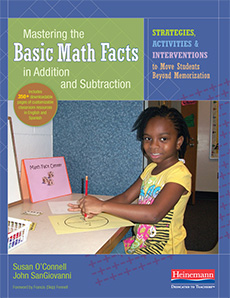
My two new favorite elementary math homeschooling resources are Mastering the Basic Math Facts in Addition and Subtraction  & Mastering the Basic Math Facts in Multiplication and Division.  Both books are by Susan O’Connell and John SanGiovanni .    Two simple books jam-packed full of resources to help your student move beyond simple rote memorization and into an understanding of number relationships and how to use those relationships in math problem solving.
mbmfas

What I enjoy most about both books is that they move far beyond pen and pencil drill sheet practice.  In the addition and subtraction book, each chapter focuses on a specific set of addition facts.  Within the chapter you are given ways to help your student see the “big ideas” of that set of facts, activities to do to explore the facts and targeted practice work. Lots of fun games and practice work ideas are given that meet a variety of learning styles.   The addition facts are then connected to their related subtraction facts to complete the picture.  The same process is used with multiplication and division.

There is a literature link for each set of facts.  The literature link is a fun way to introduce a math concept using a picture book.  I was able to find videos of almost all of the picture books being read aloud on online.  The books are also easily found at your local library.  Mastering Basic Math Facts includes guidance in how to connect the featured literature to the facts as well as math activities based on the picture books to help your child make math connections with other ideas that they know and understand.

The VERY BEST feature of these two books is that the purchase of these books includes a link to 350+ pages of downloadable resources to accompany the book!  Each game, worksheet and literature activity mentioned is a pdf printable in English or Spanish.  The resources are organized by chapter so it is easy to print what you need for the day.  mbmfmd
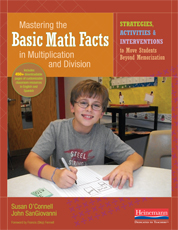
Although the book is meant for a classroom setting, I have found it totally accessible for a homeschool parent.   I have worked through the Addition and Subtraction book with my student and look forward to completing the Multiplication and Division book.   The math games are fun and don’t require much effort to put them together.   The targeted practice activities were engaging, and I appreciated the higher-level thinking skills that the thought questions require.

This is a valuable book if you are looking to strengthen your student’s basic math fact skills or introducing math facts for the very first time.  If you have a hands-on learner or a very visual student, this book will help meet their needs. Parents of special needs students will the strategies included  This book also makes for great summer math practice with low prep for the parent.  The table of contents, a sample chapter and a free downloadable sample of each book is available at the publisher’s website. 


June Links and Ideas


June is here!  A few links and ideas to add a bit of interest and learning fun to the month.

Nature study ideas for June-  The Nature Conservancy’s bird for June is the Cerulean Warbler.   The rose and honeysuckle are the flowers for June.  Why not take a day to learn more about these beautiful creations?

June is National Safety Month.  Have a family safety meeting. Do your children know how and when to call 911?  Ask your children to draw maps of your home and label the best exits in case of emergency. Then have them organize and execute a family fire drill.

Chayote_(5194455316)

June 17th is National Eat Your Vegetable Day.  Chayote anyone?  Why not browse the produce section with your children and together choose a new-to-you vegetable to prepare and eat together?

Are you headed to camp meeting this month?  Perhaps you will want to mention that on the AHE-List and arrange to meet up with other homeschooling families.  Make a few new connections!

Research topics/ideas with a June connection:

Author Helen Keller, architect Frank Lloyd Wright and American patriot Nathan Hale were all born in June.

D-Day in Normandy took place on June 6th, 1944.

King John set his seal to the Magna Carta on June 15, 1215.


Create Your Own History Curriculum – What to Study?

Yesterday in the first post of this series, we considered choosing a time period to study.    Now we’re going to think more about the specifics of what to study.

create history

Tip #2: Survey or In depth Study? There are two main ways to approach the study of history. A survey study is a broad overview of a set time frame where you cover the main events of the period. For example, you may choose to do a survey of US History from the Jamestown to the present day in one school year. It won’t be possible to give in depth attention to all events ,but you will be able to cover the biggies, like the American Revolution, the writing of the Constitution, early reform movements, industrialization and the like.

An in depth study is where you choose a few specific events, themes or people and take time to learn about them in more detail. This works well in elementary years when children’s history knowledge is starting to grow but they are interested in one particular topic. It also works well for older students who may know the general history of a topic quite well and find that they would like to spend extended time on more obscure topics that don’t generally get much attention. A high schooler might like to spend a year studying US wars in depth- American Revolution, the Civil War and World Wars I and II. If you have high schooler who is considering the study of history in college, in depth studies at the high school level would be inspirational.

What if I Miss Something Important?

One of the things you will begin to notice as your children grow older is that you will cover the main history courses more than once. Your child may go over US history three or four times during the course of homechooling. That means that you will have an opportunity to do both in depth and survey studies, as well as fill in details that you may have missed in a previous study. It’s NOT possible to cover EVERY aspect of ALL history. It is possible to give your child a good foundation of history knowledge that he can use later in life to build upon for greater understanding.

TO DO:      * Brainstorm a potential list of history interests, topics, themes or time periods. Decide if you want to do a survey or in depth study. If your child is old enough, solicit his/her ideas and do the brainstorming together. Don’t make the process long and drawn out for fear of getting it wrong or missing some important detail.

* Take a half hour to look over the North American Division’s social studies curriculum guides for K-8, and 9-12. The guides show how social studies has been organized for NAD schools and make a great reference source.
For example, we will do a survey of US History (from Jamestown to the Civil War), highlighting the American Revolution, the Constitution, the War of 1812, Westward Expansion, etc. 

https://i0.wp.com/www.wpclipart.com/world_history/warfare/Greek/Greek_phalanx_BW.gif

Tomorrow- Literature Resources for History

Create Your Own History Curriculum – Getting Started

Creating a custom history curriculum is not hard, it just requires a bit of planning.  I have enjoyed creating history courses for my children for more than 9 years starting in their elementary years and now through high school.    I’d love to share with you a few tips that will help make the process of putting a curriculum together much simpler and enjoyable.  Join me each day this week for a new helpful tip.

create history

Tip #1: Order Doesn’t Really Matter. Most homeschool history curriculums are organized into four main time periods: Ancient, Medieval, Renaissance/Reformation & Modern.  Geography & Culture studies are usually organized as a state/province and/or country study and a separate World Geography study. These time period delineations are helpful for planning, but don’t let them limit or restrict your history study goals. You don’t have to organize your history curriculum chronologically, especially at the elementary level. You can set the beginning and end of your studies anywhere along history’s timeline that you wish! If American history is where your children’s interests currently lie, then by all means, study it now! The other subjects will be there when you’re done.

At the high school level, students generally study US History (or your country’s history), World Geography, World History and US Government. Again, order doesn’t matter, though it does make sense to put Government towards the end of high school when a student is closer to voting age.

TO DO:    *Look over the typical course of study outlines for social studies at World Book’s website. That can give you an overview idea of what history topics are studied at various grade levels. Remember, those are ‘typical’ courses of study – suggestions only.

* Narrow down the general time period that you would like to cover.   It’s okay to overlap into more than one ‘era’  or  choose to cover a smaller than normal time period.

For example, you could decide to cover US History from the Jamestown settlement to the end of the Civil War.

Tomorrow-  Survey or In depth?  What If I Miss Something?

https://i0.wp.com/etc.usf.edu/clipart/24800/24874/geography_24874_lg.gif

Just Need a Small Section of a Video?

So you found a great video that illustrates a science learning goal, but you only need a small snippet of the video.  Do you want your children to view an online video but would rather not have your children on a site where they could have access to other videos?  What can you do?   Tube Chop is a free resource for ‘chopping’ out a small portion of a video.  Free and easy to use.  Click the image below to go directly to Tube Chop.

TubeChop

Scripture Song Resource

Memorizing scripture is an important part of True Education.   One way to learn new verses is to sing  scripture songs. Wayne Hooper’s Sing A Bible Verse is great resource for learning new scripture songs.   Sing A Bible Verse is free printable sheet music for more than 300 original scripture songs.  If you don’t have a musician in your home, you can find the CDs for these songs at Children’s Ministry Place. The CDs are also available at AdventSource.