This is the time of year when everyone’s talking about “back to school”. Even though every homeschool family is different, this is the time of year when homeschool forums and lists tend to ask the question “when does your school year start?”. One of the groups I’m on asked this, and when I replied that we school year round, I mentioned that we have a “lifestyle of learning”. I honestly don’t know where I learned that terminology, or if I made it up, but it fits our family beautifully. Someone asked what I meant by that, and how we accomplish that, and I answered her, but off-list (because it was too long an answer for the format of that list). And then someone else asked if I’d write it up as a blog post so she could see it too, and so . . . here I am . . . I didn’t really want to clean the kitchen this afternoon anyway LOL . . .
So, what is a lifestyle of learning? How does it look in our family? And how did we get here?
(I’d suggest getting yourself a nice big glass of sweet tea (or your beverage of choice) and settling in, because I can pretty much guarantee this is going to be a book . . . you know me!)
When we first made the tentative decision to homeschool, back when Sassy & MiniMe were about the age that Little Bit is now, I honestly didn’t realize that homeschool could be anything other than “school at home”. I looked into the future and saw us getting cute little desks for the girls, setting up the spare room like a “school room”, or us all gathered around the dining room table doing workbooks and reading textbooks. I expected us to have set “school hours” and . . . the whole nine yards. And then I started researching homeschooling, and a whole new world was opened up to me . . . gradually, I came to realize that homeschool didn’t have to mean sitting at desks (or the table) doing workbooks. And I began to realize that we were ALREADY homeschooling our children, and could do more by just shifting our thinking a little bit. I started listening to my children’s questions, and trying to really answer them . . . when they asked “why”, if I knew the answer, I told them, in terms a preschooler could understand. If I didn’t know, sometimes, if we were home, we’d go look it up. Somewhere in there, they also learned that their Papa (my dad) is a treasure trove of information, especially about mechanical things and how things work. MiniMe is my “how does it work?” child (that part is NOT “MiniME”, it’s “MiniPAPA”) and by the time she was 3 or 4, she’d ask me how something worked, I’d tell her I didn’t know, and she’d say “I’ll ask Papa” . . .
Learning to HEAR your child’s questions, and help them to learn the answers is a huge step toward developing a lifestyle of learning.
Something that goes hand-in-hand with this is developing (or maintaining, because young children are born with this) a natural curiosity in your child. I’ll never forget when a friend of mine took her son to “get your child ready for kindergarten” parents’ meeting at their local public school. It was a wealthy area, and I guess it was not uncommon for a few children each year to have attended a Montessori preschool prior to going to the public school for kindergarten. As a part of the meeting, this came up and the school personnel “jokingly” (I think?) said that they could always tell which children had attended a Montessori preschool because they were the ones wandering around the room touching everything and asking questions, “but we cure them of that” ha ha . . . when my friend related this to me, I was appalled! Why would you want to CURE children of that natural curiosity and love of learning?!?!?!? On one level, I DO understand that in a classroom setting there’s a need for order and quiet and . . . sameness, but still, it’s so sad . . . GOD gave our children a love of learning. A curiosity to learn and know and figure things out, and the way we, as a society, for the last howevermany generations, “do school” SQUELCHES that! How sad!!!
And so, if your child is still young, and has the curiosity, ENCOURAGE it!! Take time to answer his millions of questions on a side note, I found, as my children were in the 4-5 age range, that they would ask questions over and over again, sometimes, if I thought they knew the answer, or if I didn’t know the answer, or if there wasn’t ONE answer, I’d push the questions back at them, “Why do YOU think it does that?” or “You tell me.” when they’d ask a question. Often they’d know the answer, or think about it and come up with a good answer, if there was a right/wrong answer and they were wrong, we’d discuss it further and I’d answer it. Sometimes we’d still end up looking things up if we didn’t know the answer.
So, how does this work for “school”? Now that they are older, we do “do school” to some extent. I wrote yesterday about our curriculum choices for this year, so right now our mornings are mostly spent doing Bible, History, Spanish, etc. Some days we sit at the dining room table, some days we sit around the family room. Some days (not right now when it’s a gazillion degrees outside, or rainy like it is today) we go out on the patio. . . But I also recognize that learning happens other times. It happens when we are at the grocery store and I let them figure out whether it’s cheaper to buy the prepackaged lettuce or a head of lettuce, or, alternately, which brand of tomato sauce is healthier. It happens when we drive and listen to Jonathan Park or Your Story Hour . It happens when we have dinner with an old friend who mentions that she recently started keeping bees, and the girls proceed to bombard her with questions about beekeeping . . .
But another aspect of a lifestyle of learning is to recognize that, since learning happens all the time, it’s ok to NOT do the “schoolwork” part of our day sometimes. If I only counted the things I listed in my curriculum post as “school” then we didn’t do much school last week when we were in Pittsburgh. But as you can probably tell from my blog posts about the trip, we DID do alot of learning. Since we don’t take a “summer break” from the schoolwork part of our day, it gives us freedom to skip it when we have better things to do. In the spring and fall when the weather is gorgeous I’ll often send the girls outside for the whole day. In the winter when we have a perfect sledding snow, or snowman snow, they play in the snow. But last winter when the snow was here forever and icy and no fun to play in, we certainly didn’t take “snow days” just to be taking snow days, we did school then, and took “sunshine days” when the sun came back. When it’s a gazillion degrees outside we stay inside in the air conditioning and do our schoolwork. When we get a chance to go fun places and do fun things, we jump at them, that’s all learning too.
One thing that the question of “how do you have a lifestyle of learning” made me think about is how the girls take advantage of opportunities to learn. At Erie Zoo, when there was a zoo employee with some “props” near the Zebras, the girls went over and got to feel a zebra pelt, learn about how the stripes on different types of zebras are different. See a model of a zebra skull and learn how they use their teeth and tongue and stuff. The girls actively asked questions about each item, and even though this particular employee didn’t seem real thrilled to be there, the girls got alot of good information out of her. In most cases, we’ve found that employees/volunteers at zoos, museums, national parks, etc. are thrilled to meet children who are interested in whatever the topic is. One of the employees at Williamsburg last time we were there, commented that she loved homeschool week because the homeschool children ask so many great questions. There’s always the few employees who are just there for a paycheck and try to brush off the questions, and sometimes I’ve stepped in and moved the girls along (sometimes I do that because there are other people waiting to ask questions too, although there have been some times when I’ve started to move them along and the (adults) waiting to ask questions have stopped me, they’re enjoying listening to the girls’ questions and the answers to those questions and are happy to keep listening. So it’s just a matter of being aware and figuring out what needs to happen each time).
A lifestyle of learning really boils down to adjusting your mindset. View life as a learning adventure, open your eyes to the learning that is taking place all around us. If your state requires it, DOCUMENT that learning that’s taking place everywhere (if not, just notice it and enjoy it, unless you want to document it for your own records). When your children are making up a story about when they’re grown up and ask you “Mommy, when I’m 25, how old will Little Bit be?” don’t just absentmindedly say, 19. Stop and ask them “how old were you when she was born? So What’s 25 minus 6?” and help THEM figure it out. Not only will it save you, later that day, telling them how old she’ll be when they are 30 and 40 and 50, it will also be a math lesson that is much more acceptable to a child than sitting down and doing a page of math drills. And occasionally, as needed, remind yourself that the school system does things the way they do, not because it’s the best learning environment, but because it’s the easiest way to keep a large number of children from creating total chaos given the adult/child ratios that exist there. Since you have a much smaller adult/child ratio (unless you’re the Duggars LOL. And Even then, since several of the older children are now “adults” they’re still better off than the average classroom), you don’t have to do things in the same way. You don’t have to have your child do a worksheet to “prove” that they read a book, you can just ask them, “so what did you think of that book?” chances are they’ll give you an ear-ful and you’ll certainly know if they read it or not, and probably if they understood it or not. It would be hard for a teacher to do that with each of the children in the classroom, and a “group discussion” allows the child who didn’t read to just sit quietly and the teacher might never notice. But you only have one, or a few, children who read the book, so just ask what they thought.
Similarly, I see no point in “reading books” beyond the “learn to read” stage. I make sure we have plenty of interesting looking books around and keep an eye on when/if/how much they’re reading. There’s no “assignment” to read, and they’re learning to love reading, which is the whole point. If we’re going in the car I’ll often suggest they bring a book along. Or if we’ll be somewhere that they’ll need to wait quietly for awhile. I can tell that their reading is improving by noting the difficulty of the books they read (not by using “reading books” just being aware. When Sassy recently read Eight Cousins with only minor questions about what words were or what they meant, I figure she’s doing fine for an 8 yr old. I’ll also sometimes have them read Bible texts and such aloud as part of Bible or their Sabbath School lesson, which also helps me gauge how they’re doing in reading.
So hopefully somewhere in all my babbling you learned abit about how to have a lifestyle of learning, whether you choose to send your children to public school or private school, or do school at home, or be as eclectic as us, you can still have a lifestyle of learning and help your children love learning now and for a lifetime.
Today’s post is courtesy of LaRee . You can read the post on her blog Broad Horizons.
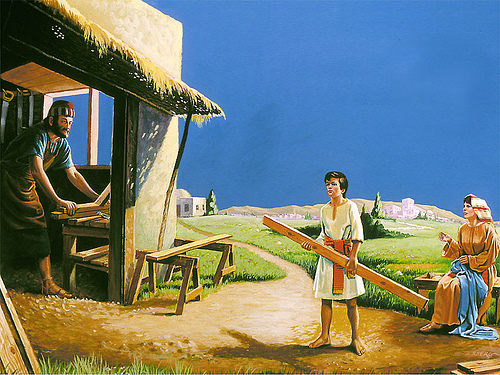 “There is an important lesson for parents and children to learn in the silence of the Scriptures in reference to the childhood and youth of Christ. He was our example in all things. In the little notice given of His childhood and youthful life is an example for parents as well as children, that the more quiet and unnoticed the period of childhood and youth is passed, and the more natural and free from artificial excitement, the more safe will it be for the children and the more favorable for the formation of a character of purity, natural simplicity, and true moral worth.”



 The Adventist Home Educator